VOLUME 32, ISSUE 7. February 2026
|
|
|
|
|
Members at the club Christmas Party 2025 |
|
|
Casting Practice
8 Feb 2026 l 9:00 AM l Timbrell Park, Henley Marine Drive, Five Dock
Monthly Meeting
9 Feb 2026 l 7:00 PM l Freeway Hotel, 115 Reserve Road, Artarmon
Fly Tying
16 Feb 2026 l 6:30 PM l Freeway Hotel, 115 Reserve Road, Artarmon
Jindabyne Tuition
20 Feb 2026 l 2:00 PM l Piste Haus Jindabyne |
|
|
|
|
|
|
"The act of fishing transports us to a special world, and a state of mind, where we are free." Fennel Hudson |
|
|
|
|
|
|
Dear {Contact_First_Name},
Welcome to 2026 and what is shaping up to be another great year at Sydney Flyrodders. Your committee is working hard to ensure that there is something for everyone on the calendar this year.
Congratulations to club member Jared Klein who has been selected for the Australian team for the Oceania Championships being held in New Zealand in April.
As I was unable to attend the Christmas Party, I would like to thank Denis for stepping in and taking on my duties. Also, I wasn’t able to congratulate David Caddies on receiving the Mark Bransgrove Award and Brian Henderson on being appointed our first Honorary Member. Both of these are recognition of outstanding service and contribution to our club.
This month we have our monthly meeting and fly tying at the Freeway Hotel, casting practice at Timbrell Park, a salt water social event and a weekend at Jindabyne. In addition to our regular activities in March we have two days of casting tuition with Brian Henderson and one of our annual trips to Victoria – the Big River Trip.
A huge shout out to the committee and club members who have take on the responsibility of planning coordinating and running these activities!
No doubt a lot of you (like me) have been watching the news regarding the bushfires that swept through Victoria – the fire in the Nariel Valley is still burning. Our thoughts and prayers (I know that this is a somewhat overused phrase) go out to the local communities and the emergency services.
Looking forward to seeing you at a meeting or an event.
Tight lines.
David
President |
|
|
|
|
|
|
|
|
Jason with a Mowamba rainbow |
Fellow Flyrodders,
Welcome to the first Fly Rodder of the year.
In this edition, Henry Han reports on the recent saltwater day where some our more experienced members shared their knowledge with others while out on the water. Henry felt he walked away a better caster and a satisfied customer thanks to the club BBQ.
Bob Hart reports on his latest trip to the South Island and generously shares some nuggets of wisdom he’s learned from guides over the years. If you’re planning a trip to the South Island it is well worth the read.
For those members going on trips over coming months, whether with the club or separately, please consider taking the time to write a report with a few photos to send through to me. It is an important part of being able to publish our club newsletter every month.
Thanks to our regular newsletter (and club) contributors David Caddies and Dave Wilson. With the expertise you so kindly share, members can both create and deliver feathered offerings with aplomb. Cheers Jason Hemens - Editor |
|
|
|
|
|
|
|
|
|
|
By Henry Han
With my partner away once again and Michael Leung somehow securing another well-timed leave pass, we teamed up for another club Saltwater Day on Sunday 1st February 2026 – this time at Henry Lawson Reserve, Abbotsford. We had 15 members attend, and by the time I arrived at 9am, people were already spread out across the bay and well into their fishing. We fly fishers are clearly an enthusiastic bunch!
After a few waves and nods hello, I started with the same bread fly and burley approach I used last session. Unfortunately, the fish must not have received the same memo – they showed very little interest in anything I offered, fly or burley! I switched to a Clouser for a while, but with the same result. From the look of it, Michael and several others were facing similar challenges. Still, even though the fishing was quiet, the day turned into a great reminder that these sessions are about far more than just catching fish.
A real highlight for me was when David Caddies – a superb fly fisher and an even more fabulous casting instructor – kindly came over to help with my casting. I was lucky to spend quite a bit of time with David, who took me through the basics of pick-up and lay-down casts as well as roll casting, but also the feel of a good cast. A big focus was on maintaining proper line tension and using smooth, progressive acceleration rather than forcing the rod. When it came together, you could really feel the line stay connected and the loops tighten up.
For the pick-up cast, David shared some great little tricks. One was watching the line as it lifts – you want to see water dripping off the line but no bubbles or splashing, which means you’re lifting cleanly rather than ripping it off the surface. Another tip was to stop the back cast right at the moment the fly just “pops” free from the water. Getting that timing right made a huge difference to how controlled and effortless the cast felt. Having everything broken down so clearly really helped the fundamentals click into place.
New member Daniel McAdams was also receiving excellent guidance, and I happily joined in to reinforce my own learning while he was being coached. Daniel also benefited from tuition by Steve Peach and John Baricevic – a perfect example of one of the great things about our club: experienced members are always willing to share their knowledge.
All that casting practice definitely worked up an appetite, so once I overheard the BBQ getting started, I packed up my rod pretty quickly! But before fully committing to lunch mode, I noticed Daniel and Steve Peach working on some interesting casting techniques, so I wandered back over. I was lucky enough to get some guidance from Steve on double hauling, and during the session I even had the chance to try his fabulous Sage R8 Core. No pressure at all casting someone else’s pride and joy right in front of them!
With David’s earlier tutoring on line control and smooth casting, plus having watched Steve’s video beforehand, I think I managed an OK job with double hauling for a first proper attempt. Plenty more practice is needed, but it felt great to start putting the pieces together.
Although the fish weren’t particularly cooperative, the atmosphere certainly was. Paul Cooper kindly provided his special berley, which kept our hopes up and conversations flowing while we worked the water. Onshore, Allen Dinham did a sterling job manning the BBQ as always – dependable, efficient, and very much appreciated once rods were put down and appetites kicked in. Gavin van der Wagen, as always, made everyone feel like a welcome guest in a mate’s backyard.
There is never a shortage of jokes and stories once we’re out of the water. John earned the nickname “Scientific Angler” after confidently explaining that “there’s no wind near your feet, so a lower cast works better on windy days.” Tim Ford also shared his bonefishing adventures, which inspired me to add yet another species to my ever-growing bucket list.
Days like this really show what the club is about: learning, sharing, trying new gear and techniques, and enjoying good company by the water. The fish will play ball next time. In the meantime, Daniel and I are definitely casting better than we were before.
Thanks to everyone who came along and contributed to another great club day. Looking forward to the next one. |
|
|
|
|
|
|
Daniel McAdams in foreground |
|
|
Dave Webster (foreground) and Paul Cooper out deep
|
|
|
Craig Symonds contemplating life (or maybe just untangling his reel)
|
|
|
The Cooks Allen Dinham and Paul Cooper |
|
|
John Baricevic and David Caddies
|
|
|
Trip Report - Fishing New Zealand's South Island |
|
|
Spring time on the South Island |
By Bob Hart
There are some of our members who fish throughout the year. However, there are others, like myself, who fish from time to time. I think it is most important for fishermen, like myself, to attend one of our clubs casting classes before we go out to fish. I have been fly fishing for over 25 years, and if you do not do it on a regular base, bad habits creep in. I wisely attend one of David Caddies excellent casting classes before travelling to New Zealand. However, it is not enough just to attend one of David’s classes. You must also practice what you have been taught in order for you to reinforce muscle memory. Personally, I think it is very relaxing to spend thirty or forty minutes practicing casting accuracy. As we all know tight loops aid in accuracy, and are paramount for handling windy days.
Back to my fishing report. I flew into Queenstown, where my good friend and guide, Ian Cole, was there to greet me. As well as being a fishing guide, Ian is a qualified FFFI casting instructor.
Rather than tell you what we released, I am going to inform you about what flies to use when you travel to New Zealand. I’ve learned this information from Ian, and also observing what flies other guides use at different times of the year.
Ian maintains that fly choice is made simpler by a basic understanding of what trout food forms are naturally available to trout.
Basically these food forms are split into two groups of flies: Terrestrials and Waterborne.
There are basically 2 types of flies - ones that FLOAT (dry flies) and ones that SINK (wet flies, nymphs and streamers).
Dry flies most commonly used during the summer months include terrestrials such as beetles, cicadas, willow grubs, grasshoppers, ants and blow flies. Waterborne food forms appear throughout the year and include mayflies, caddis, midge, fish, corixa, damsels, dragonflies and snails. These can be dry, nymph, wet flies or streamers.
Ian believes, when selecting a fly for an area you have never fished before, check out the stream/ or lake bottom to establish the food forms which are available – paying close attention to size and colouration. The best patterns suggest a number of food forms rather than exactly imitating a specific one. This coupled with correct presentation for that particular food form increases the chances of success.
When fishing rivers, nymphs like perdigons help to get the fly down quickly. Pheasant tails, hares ears in sizes #14 and #16 with varying degrees of weight are all good choices. Caddis nymphs and pupae and elk hair caddis in # 14 are also good choices. Consider mayfly patterns like parachute adams, spinners, emergers and terrestrials. Midge pupae, corixa, damsels are good choices for still waters and quieter margins or rivers.
If you are going to fish on your own in New Zealand without a guide, these flies will be a good way to get started.
When I travel to New Zealand, I take along my trusty Sage XP 9’ in 5 and 6 weight. These rods have served me well even though they are now over 26 years old. While I was attending a club casting session, a member let me use his brand new Epic 6 weight graphene rod. I was most impressed with its lightness, and sensitivity.
I told Ian, who is an ambassador for Epic rods, about my experience. Ian commented that Epic was founded by owner Carl McNeil, who is a master caster instructor for the FFFI. Carl designed Epic rods to be “soulful” fishing rods together as well as having delightful casting attributes. They are certainly not “sticks” – they bend from the butt and offer awesome cushioning for fighting fish.
Ian let me use his Epic 5 weight graphene, and the latest 6 weight model 690TI, which stands for titanium. At first I used the 590G or the 5 weight as it was used with little wind. The rod was as light as a feather, and when a fish was on you could feel it. The rod is light, strong and sensitive. But during the latter part of my trip the wind picked up, and Ian took me to lakes. Here is where I used the 6 weight. Although we experienced strong winds, the 690TI handled the situation with ease. Although the rod is very light and powerful, it is still sensitive enough to feel the fish. When a fish was on, the rod bent progressively down towards the butt. Due to the fact that the 690TI is designed for both fresh and saltwater fly fishing, it has larger guides.
To say that I was impressed with these rods is an understatement. I still think my XPS are good rods, but as Ian has reminded me, you are looking at twenty-five years of improved technology, and that is hard to beat.
I had a wonderful time that was educational, most enjoyable, good weather, good fishing, and to top it all off, I met two fantastic fellow fishermen. What more can I ask for? |
|
|
A 6 & 3/4 brown about to be released |
|
|
Club Christmas Party 2025 |
|
|
Guest speaker Brian Henderson fielded questions expertly with a whiteboard, marker and fly rod |
|
|
Brian presenting club stalwart Gavin van der Wagen with his FFI Gold Level Casting Certificate |
|
|
Dave Wilson receives his FFI Silver Level Casting Certificate |
|
|
And another silver goes to Wayne Laughton |
|
|
Liz Bransgrov presents David Caddies with the Mark Bransgrove Award for outstanding services to the club |
|
|
A worthy recipient of the inaugral Mark Bransgrove Award. Thank you David for your outstanding contribution to the club |
|
|
Denis did a wonderful job on the night |
|
|
General merriment and good cheer |
|
|
Next Monthly Club Meeting
|
The Monthly Meeting will be held at our regular venue, The Freeway Hotel, commencing at 7:00pm on Monday 9 February. Members will arrive from around 6pm so feel free to come early and enjoy a drink and some dinner with fellow members.
Our speaker will be one of our own club members, Pedro, who will be discussing fly fishing opportunities in Chile. Pedro undertakes an annual trip back to South America to undertake education activities that include fly fishing. There are potential opportunities to join him as part of his program. He has developed a network of local connections that put him in a position to fish some spectacular waters, so you may find out about some great waters.
There may also be some feedback from club members who have recently returned from a South American trip.
So come along and enjoy another great night out with fellow members. |
|
|
|
|
Casting Practice Report (Dec 2025 / Jan 2026) |
|
|
FFI Master Casting Instructor David Bracks leads the session. |
By David Caddies
Two casting sessions in one report, this time, due to the January hiatus in the Flyrodder.
Over both sessions, 33 individual members turned out, 11 of them doing so on both days. There were also the 20 or so who also came along to Brian Henderson’s casting tuition day at Narrabeen the day before the club Christmas dinner in December. So, summertime seems to be the prompt for getting serious about casting.
In December, we were joined by FFI Master Casting Instructor David Bracks to lead the session. David took us through some exercises calculated to heighten our sense of feel when it comes to our rod and line. We made every effort to find out just how our rod ‘likes’ to be handled. Some rods seem to respond better when moved fast, some slow, some in between. We spent time feeling for our rod’s sweet spot just by moving a short, fixed line in the air (eg a figure 8 move) till the tempo seemed ‘right’. I can only express it as a feeling that when you found the spot, the rod and line kind of blended and all I felt was my arm moving a smooth weight around. Really interesting when you get that and then move on to comparing it with a different rod or a different length of line. Rods have feelings, you know, so get in touch.
We then moved on to doing the pick up and lay down cast with eyes shut. Yes, to a target distance. Deprived of a crucial sense we always use otherwise, we were forced to think through in detail the moves to make the cast required. The clear value of this exercise is to force the caster to know, recall and mentally prepare to make the correct sequence of moves to make the cast. Thinking about what and how to do things during a sporting activity happens naturally, but over time that becomes less obvious to us, particularly as we become more proficient. But, try spending time doing some thinking before acting and you’ll find your brain changing gear and you’ll be slowing down mentally running through and then doing the steps in a very deliberate way. Ie the process becomes conscious. What for? Because mindful (conscious) learning develops competency sooner, which eventually leads us to unconscious casting competence on the water. This has clear application to casts which are new to you, or which you need to improve on. Don’t be fishing and figuring out how to do basic casts at that time – it needs to be “in your fingertips” so you can concentrate on the fishing situation.
Casting with eyes shut is a learning tool. Compare it with a pilot checklist before take off. (May your pilot always do the checklist before take off, not during or after.) You will be surprised how it accelerates your grasp of technique when you try it. Then you remember it better: then you send it into ‘unconscious mode’ sooner. Another advantage is that it will slow down your practice routine and help your self-assessment of how you are going. As Simon Gawesworth says about casting practice “Think more, cast less”.
What we aim to do at the club casting practice day is to make practice routine and effective, not just how to cast. So, it’s casting as well as casting practice. So, for a start, do as much thinking as casting. Whenever you try out the checklist approach before making a practice cast and realise that you don’t know how all the moves fit together, or you know step 1, 2 and 3, but not 4, understand that you are at a real learning moment. The same goes for knowing all 4 steps, but in execution, the result is not what it should be. This is where the gaps show up – eg in the nuances of timing, rod angles, joint movements etc. etc. At this stage, you are about to learn that it’s probably 5 steps, not 4, and you will realise that because you cast with real purpose and your own thinking process revealed the shortcoming in that cast you made. Knowing what you don’t know is a vital step in casting progress. Knowing how things are supposed to work, or how they actually work, is the icing on that cake.
There was a moment at the January session where a member brought out a sinking line to discuss technique with me. He had obviously given it some trial and consideration, because the first thing he said was that he found he had to cast slower with the sinking line than other lines to make an effective cast. In other words, his own experience led him to find out something fundamental about line types when making a cast. Clearly he must have stopped and thought it through to reach his conclusion. Had he not persevered and found a workable method he might, like many people would, put the sinker back in the cupboard and not bothered.
So, pulling all this together, casting practice is about:
- Sound knowledge and execution – patiently, cast by cast, leading to good casting fundamentals
- Purposeful practice – have short-term goals and clear wins, no matter how minor.
- Self-discovery – look for the reasons - why and how. Spot rabbit-holes and enter freely.
See you in the park
David |
|
|
Bob Hart (centre) practicing the “pull down” casting technique. |
|
|
David Caddies recites the Ten Commandments of Fly Casting.
|
|
|
Three blokes walk into a bar...
|
|
|
Brian Henderson’s casting tuition day at Narrabeen (day before Christmas Party).
|
|
|
Club Monthly Casting Practice - Details and Event Schedule. |
|
|
SFRC MONTHLY CASTING PRACTICE 9am Sunday 8 February 2025
Reminder: Leave your 9 – 10’ trout leader with the 5X tippet at home. Bring one which is 8’ – 8’6” and terminating in 8 or 10 lb tippet. This session will suit DT or WF floating lines, for the single-handers. Two-handers, bring what you got.
Start time is 9am:
HOWEVER: If you wish to have a go at being evaluated for any one or more of the casts in the Bronze Skills Development Program and you would like to come earlier than 9, send me a text message to that effect on 0434 671 085 and I’ll be there to set it up, from 8am. Coaching and demonstrations will be going on after 9, but with not much opportunity for individual evaluations. Early notice would be appreciated, but don’t let that stop you from a late practice on Saturday to see if you’re ready!
All members are welcome to join in the club’s usual monthly practice session. If you want to know everything about the club’s casting practice sessions, read the whole blurb in the Flyrodder magazine.
WHERE: Timbrell Park, Henley Marine Drive, Five Dock. Go to the western end of Henley Marine Drive, past the cricket pitches, baseball nets and just past LIvvi’s coffee kiosk and kids’ playground area. There is an open area opposite where Ingham Avenue intersects with Henley Marine Drive which we usually use. It is not part of the sports fields. If conditions there are not suitable on the day, we will be just opposite, across the canal, or anywhere within sight that I can find.
So come and give it a try, as there is so much to be gained by attending these sessions. And they are Free!!!
If you can’t make it this time and want some good practical instruction to guide you, check out this site: https://www.flyfishersinternational.org/Learn/Learning-Center-Resources/Fly-Casting/Casting-Instruction
I don’t know if that link works for you. Google FFI flyfishing and delve around. Most stuff is open to non-members.
2026 dates for fly casting practice
8 Feb I 8 March I 12 April I 17 May I 14 June I 12 July I 9 August I
13 September I 11 October I 8 November I 13 December |
|
|
|
|
|
|
|
|
By Dave Wilson
The Tabanas is a Parachute Caddis pattern ideal for summer conditions that may also be taken as a hopper. It is of European origin and popularised in Australia by international competition anglers. A “go-to” pattern of Tom Jarman.
The Tabanas is very oddly named. Tabanus is the name given to Horse Flies (Tabanidae family) which are not related to Caddis’s at all. While on nomenclature, you will hear the name “Sedge” given to Caddis flies. Sedges and Caddis’s are the same fly. “Sedge” is commonly used the UK usually in company of Harris Tweed coats and deer stalker hats! They are called Caddis’s in Australia and the USA.
The Tabanas however is packed with core tying skills that are transferable to many other patterns. It is not easy to tie as managing flair of soft hair, tying a parachute hackle and maintaining proportion can be challenging.
Tying the parachute hackle while not fouling the hair wing can be tricky without applying a “secret” method. So come along to learn these skills at the next fly tying night on 16 Feb 2026 at 6:30 PM at the Freeway Hotel. |
|
|
|
|
We extend a warm welcome to new members Robert Evans, Jarryd Knapp, Daniel McAdams, Francesco Melandri, Nigel Pennington, Vincent Sweeney, Claudio Venegas, Terry Vincent and Conny Warn. We encourage new members to join in on the many activities that we run as this is a good way to meet other club members and also to improve your fly fishing skills and most importantly to have a great time.
Looking forward to meeting you at our Monthly Members Meetings and at events throughout the coming year.
|
|
|
|
|
Sydney Fly Rodders Facebook Pages |
We run two SFRC pages, one is our public page and it posts events and activities of the club. It also shares posts from other pages like CAS, DPI on things relevant to the places and areas that we fish.
I post some fly tying every now and then and share links to events I find that might be of interest to followers. This page is a little like our Web page, it showcases the club to attract members and provides details of club events. At last count it has more than one thousand followers.
We added another page. This is reserved for members only and cannot be seen by anyone outside of the group. You will need to send a request to join. Any member can post on this page and it is a great opportunity for members to put up a post or two about anything fly fishing. I would like to encourage members to use this page to post fishing reports or photos of flies that you tied. Being connected to other members you can ask for some casting or gear advice, or organise a short trip when you suddenly have some spare time.
There are also hundreds of other groups; bream on fly, carp on fly, bass, trout....areas like alpine trout, Sydney Kayak Fishing....fly tying groups, buy sell swap fly gear pages and individuals like Aussie Flyfisher, Sydney Flyfishing to check out.
Phil Burton
philipburton@bigpond.com |
|
|
Sydney Flyrodders Instagram Page |
|
|
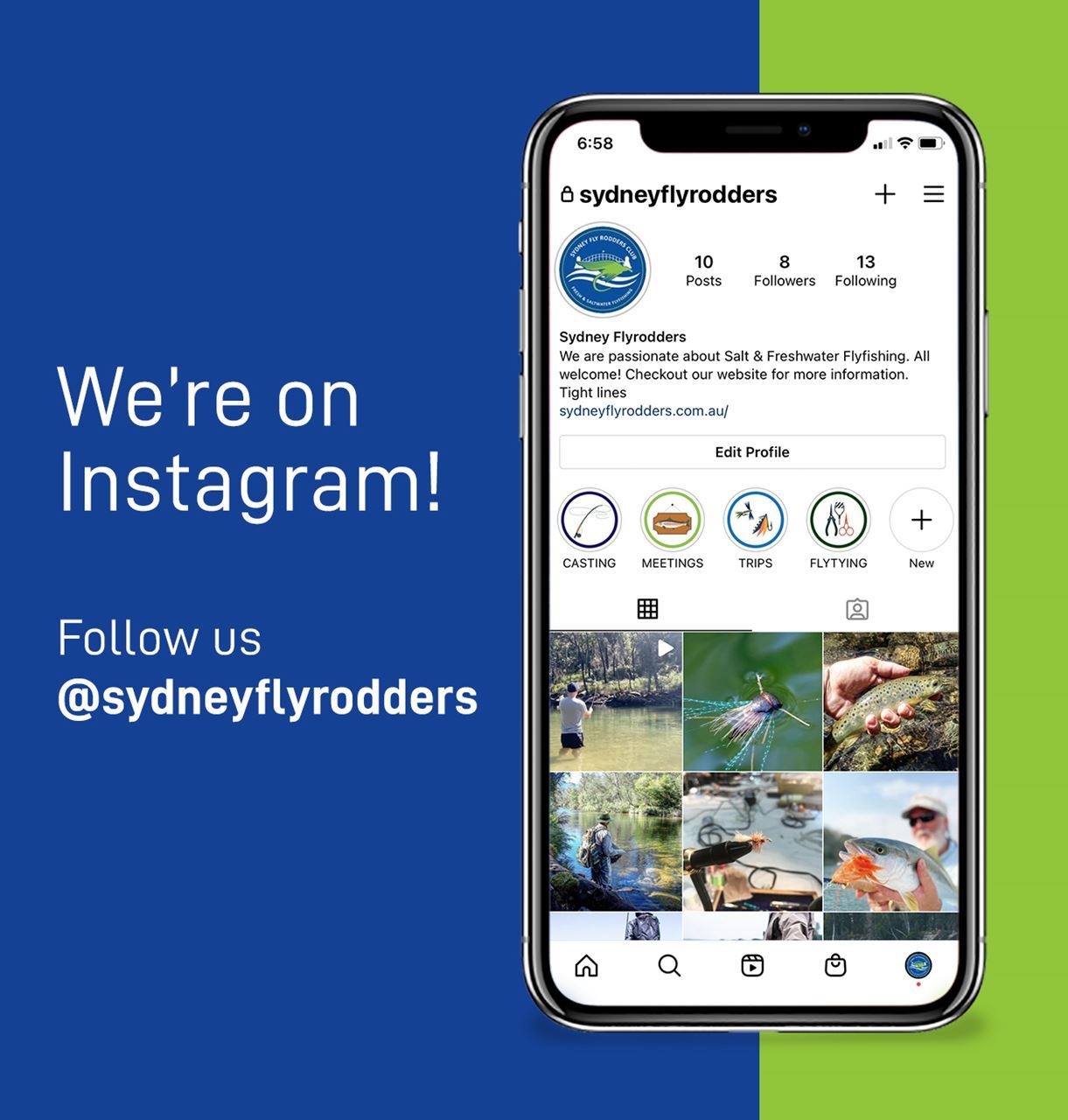
The Sydney Fly Rodders are now on Instagram. Many thanks to our Member Maddie Chew Lee, who offered to set us up and apply her significant experience with marketing and communications in particular within the social media space.
Please follow the site and add your comments, and lets grow this platform for the club. It will also attract new members to the club.
Below is a snapshot of the site. We aim to sync (in particular look and feel) the Instagram account with our Facebook account and also our new Website, which I talk more about in the preceding section. |
|
|
Sydney Fly Rodders WhatsApp Group |
We have an Exclusive Group on WhatsApp for our Members, which is a great way to communicate informally and to share ideas, seek advice and also to plan and seek interest for impromptu/planned fishing trips.
I can highly recommend this to members. We have arranged a number of trips now from a weekends bass fishing through to a casual and social Sunday morning or afternoons fishing at Narrabeen Lake or Hen & Chickens Bay etc. And there could even be a BBQ thrown in for a social get together afterwards. This will happen on most if not all occasions.
Should you wish to be included in this group, then please email me to request your inclusion, quoting your mobile number which is required to link you into the Group. You will need to download the WhatsApp first if you haven't already done so.
Please contact me for inclusion.
Jason Hemens Editor, Flyrodder jasondh1972@gmail.com |
|
|
Piste Haus Ski Lodge - Jindabyne |
|
|
The Fly Rodders have access to the Piste Haus Ski lodge in Jindabyne during the off season at an affordable rate:
- Positioned in Jindabyne village walking distance to Banjo Patterson Pub and short drive to shops/restaurants/etc.
- 8 bedrooms, mix of doubles, twins, triples and bunks
- Sleeps 14 all up and 10 comfortably
- $75/room/night
- SFRC get access from October to end May (off-season for skiing)
- Large open plan and well-appointed shared kitchen, dining and relaxation area with log stove
- Bring your own linen, towels, pillow, sleeping bag, blanket
- Parking for up to 4 or 5 cars on site and others on the street
The syndicate that owns Piste Haus has been very generous in allowing the Sydney Flyrodders access to this excellent facility at such a low price. Therefore, we encourage members to feel free to make use of this offer (either in groups or as individuals – it does not have to be an official club trip), as long as we always remember to follow the house rules and leave the place clean and tidy.
If you are interested in booking please reach out to James Webber (treasurer@sydneyflyrodders.com.au
https://pistehaus.com.au
|
|
|
|